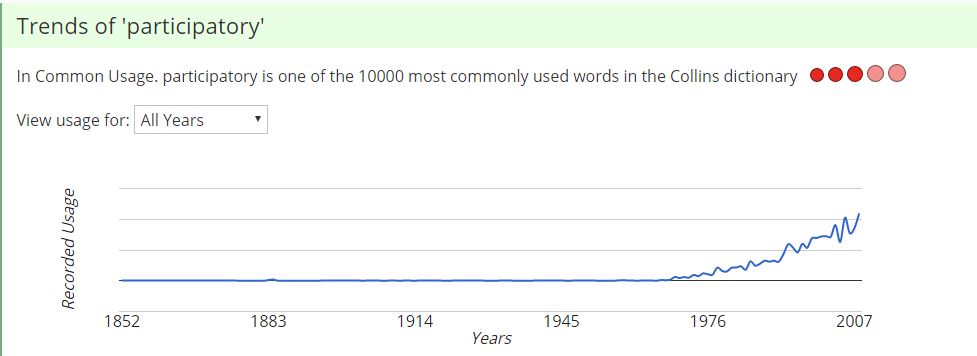
Merriam-Webster dictionary defines participatory as “characterized by or involving participation especially: providing the opportunity for individual participation” (Merriam-Webster, 2019). I was curious to see the history of the use of this word and the graph below clearly aligns with my thoughts on this subject. The use of the word starts to trend in the 1970s. Eminent Sociologist Manuel Castells had observed that the engineering innovations of the internet were accomplished by graduate students and that they were ‘permeated with the values of individual freedom, of independent thinking, and of sharing and co-operating with peers- all the values that characterized the campus culture of the 1960s” (Castells, 2001, p.24). During that same period, the idea of ‘gifting’ was also present in the hacker culture when students in academia and science were able to share code, modify it and re share it (Anderson, 2012). The point I want to make is that this participatory environment has been the bedrock of the internet since its conception. So it may be no surprise the increased use of the word participatory aligns with this explosion of the internet during that period.
Of course participation in media has been around even before the internet like students participating in writing and producing school newspapers. I would however like to focus on digital media here. Let us move forward a few decades. The emergence of Web 2.0 tools has been integral in user generated content (UGC) and participatory culture. Examples include blogs (of course!) and wikis as well as social media platforms. In fact, Time’s 2006 person of the Year was YOU! The cover had a picture of a computer screen and keyboard. The image says it all.

Then-managing editor for the magazine Richard Stengal acknowledged “that largely thanks to the power of the Internet, individuals were wielding power in new and dramatic ways” (Waxman, 2016, p.2). In a sense, it can seem scary that one person may have so much influence over a large part of society, on the other hand, power is not just in the hands of a few select people in society any longer. In this video, cultural anthropologist Mary Ito describes how students of today are engaged in friendship and interest driven participation online. The key is to recognize the difference between the two and how adults and educators not perceive one space as being better than the other. Friendship driven participation teaches students how to navigate the social environment which is a crucial element of growing up. On the other hand, in interest driven participation (which Ito aptly refers to as the “geeking” out or messing around space) it is where some of them become involved in interest groups like fan fiction, creating YouTube videos, podcasts remixes. Activities like these can then lead to community or civic engagement. The question she poses is how adults handle and manage these spaces. The answer is the need to come together to introduce guidelines for both adults and children to be able to interact safely in these spaces. In this clip, Henry Jenkins who is the Director of Comparative Media Studies Program at the Massachusetts Institute of Technology echoes the same sentiment on how educators and parents cannot just leave kids to their own devices in the online world, but that we need to guide them and provide support. Instead of individual teachers attempting to teach participatory media literacy, schools as a whole need to be engaged as well.
Circling back to the concept of ‘gifting’ that I had mentioned earlier, Jenkins also mentions it the context of how kids produce and share media so they can learn from one another. It’s a gift of teaching and learning that they give one another. Where is all this leading? One interesting development is kids becoming more participatory in the political environment. The success of the Obama presidential campaign proves this point. It is evident that then Presidential candidate Barack Obama was very savvy in how his campaign used social media to engage people in political activism. They were able to use media like blogs and videos “to motivate their users and their social networks to involve friends and community members in online or text-based political and social discussion. Once activated, many supporters used these media to create their own politically-focused media content, and enlisted further support by sharing content with their media capable personal networks” (Goodman, Wennerstrom & Springgate, 2011, p.95). This to me is the essence of participatory media. I would like to leave you with this YouTube video of Sarah, a young girl who wanted to express her excitement on watching President Obama give a speech live. Would we not want her to be equipped with tools and knowledge on how to be media literate as she participates in her interests in a safe, thoughtful, positive manner? Shouldn’t we as a society want future generations of children to be informed, involved and responsible digital citizens? As adults, how do we embark on this journey with our kids?
References
Merriam-Webster, Incorporated. (2019). Retrieved from https://www.merriam-webster.com/
Anderson, P. (2012). Web 2.0 and Beyond. Boca Raton, Florida: CRC Press.
Castells, M. (2001). The internet galaxy. Oxford: Oxford University Press.
Collins. (2019). Retrieved from https://www.collinsdictionary.com/dictionary/english/participatory
Edutopia. (2013, May 7). Henry Jenkins on participatory culture (Big thinkers series) [Video podcast]. Retrieved from https://www.youtube.com/watch?v=1gPm-c1wRsQ
Edutopia. (2013, October 22). Mimi Ito on learning in social media spaces (Big thinkers series) [Video podcast]. Retrieved from https://www.youtube.com/watch?v=HF5pxnXwMBY
Fryer, W. (2009, September 8). Sarah’s response to President Obama’s speech. [Video podcast]. Retrieved from https://www.youtube.com/watch?v=jTBnApR7gI0&list=PL9B9DC6037CD6DBB9
Goodman, J., Wennerstrom, A., & Springgate, B. (2011). Participatory and social media to engage youth: from the Obama campaign to public health practice. Ethnicity & Disease, 2(S), 94-99.
Hartrell, G. (2017). Where did hacker culture come from? Retrieved from https://www.forbes.com/sites/quora/2017/09/07/where-did-hacker-culture-come-from/#141ff7443362
Waxman, O. (2016). It’s been 10 years since YOU were named TIME’s person of the year. Retrieved from https://time.com/4586842/person-of-the-year-2006-2016/
Wikipedia (2019). Fan Fiction. Retrieved from https://en.wikipedia.org/wiki/Fan_fiction
 Embrace Tech Education for Children